Incident Management Procedure & Manual
Reporting, investigation, corrective actions, follow-up and recurrence prevention — operated within the JR Matrix Operating System.
Purpose & Scope
This Incident Management Procedure & Manual defines how Jordan Rail Pty Ltd records, investigates, actions and follows up all work health, safety and rail-safety incidents, injuries, near misses, hazards and property/environmental events across its operations.
It applies to all Jordan Rail employees, contractors and visitors at rail corridors, civil work sites, workshops, yards and in transit. It operates within the Jordan Rail Operating System (this platform), which is the single system of record for every incident report, investigation, corrective action and follow-up record.
This document supports, and is governed by, the Jordan Rail Safety Management System and JRSE-110 Safety and Environmental Requirements, and is aligned to ISO 45001:2018 clause 10 (Improvement) and the WHS Act / Regulations.
Definitions
- Incident - any unplanned event resulting in, or with the potential for, injury, ill health, damage, loss or environmental harm.
- Injury - any physical harm or illness to a person arising from work activity.
- Near Miss - an event that did not result in injury or damage but had the potential to do so.
- Hazard - a source of potential harm that has not yet caused an incident.
- Property Damage - damage to plant, equipment, infrastructure or third-party property.
- Environmental - any release, spill, contamination or ecological impact.
- Notifiable Incident - a serious incident that must be reported to the regulator (WHS regulator and/or ONRSR) within statutory timeframes.
- Corrective Action - a defined, assigned action intended to eliminate or control a root cause and prevent recurrence.
- Action Tracking Register - the platform register that consolidates every corrective action across all incidents and tracks it to verified close-out.
Roles & Responsibilities
- All Workers - report all incidents, injuries, near misses and hazards immediately and assist with site preservation.
- Site Supervisor - secure the incident scene, provide immediate assistance, notify management and begin the initial report.
- Reporting Person - completes the Incident Report in the Operating System, including persons involved, description and immediate actions.
- Investigation Lead - assigned manager who conducts the investigation (5 Whys, fishbone, team investigation or desk review).
- Action Owners - assigned persons responsible for completing corrective actions by the due date and recording completion notes.
- HSE / Operations Manager - reviews severity, confirms notifiable status, notifies regulators, approves close-out and verifies effectiveness.
- Management - reviews incident trends and the Action Tracking Register at management review and authorises recurrence-prevention measures.
Incident Classification & Severity
Every incident is classified by type and assigned a severity level at the point of reporting. Severity drives the level of investigation, notification and escalation.
- Types: Injury, Near Miss, Hazard, Property Damage, Environmental, Security, Other.
- Severity levels: Low, Medium, High, Critical.
- Critical / High severity and all notifiable incidents trigger immediate management notification and site preservation.
- Risk assessment (likelihood × consequence) is recorded on each incident to confirm residual risk after controls.
Incident Reporting Procedure
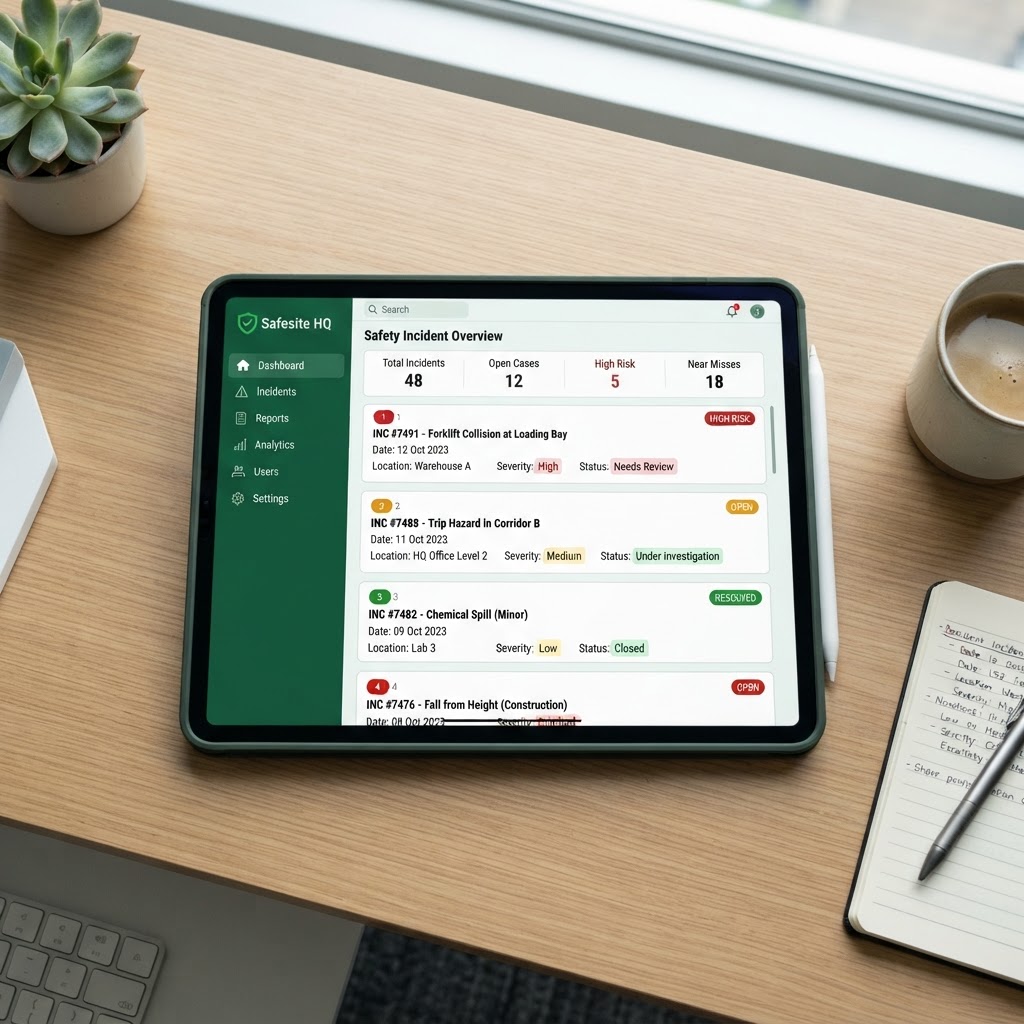
The reporting workflow below is executed inside the Operating System. All workers can report an incident; managers and admins manage the lifecycle. The figure shows the Incident Reporting dashboard where every report is listed with status, severity and type.
- Step 1 — Make the scene safe and provide first aid. Preserve the incident scene where it is safe to do so.
- Step 2 — Notify the site supervisor and management immediately for any injury, high/critical severity or notifiable incident.
- Step 3 — Open 'Report an Incident' (Health & Safety → Incident Reporting, or /report-incident) and complete the Incident Details tab.
- Step 4 — Record persons involved, immediate actions taken, witnesses and photos at the scene.
- Step 5 — Assign incident type, severity, date, time, location, project and client context.
- Step 6 — Submit. The system auto-generates a report number and sets the status to Open.
- Step 7 — Management triages the report: confirm severity, set status to Investigating, and decide on notifiable/regulator reporting.
Recording the Incident in the Operating System
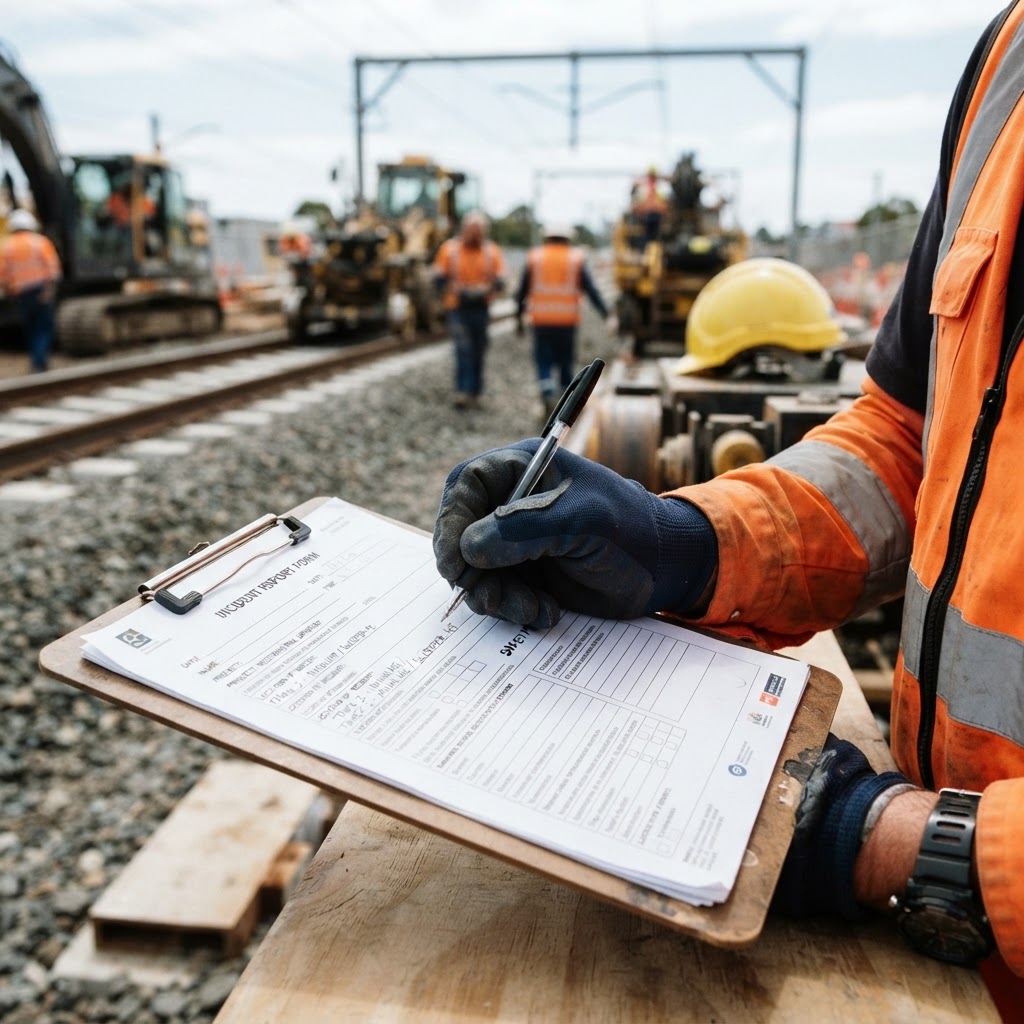
Every incident is recorded with a unique auto-generated reference number, author, timestamp, photos and full context. The report form captures details, risk assessment, root causes, corrective actions, follow-up, response and close-out across tabbed sections.
- Incident Details — what happened, where, when, who was involved and immediate actions.
- Risk Assessment — likelihood, consequence, existing and additional controls, residual risk level.
- Root Cause — categorised root causes (human factor, equipment, environment, procedure, management, other).
- Corrective Actions — assigned actions with responsible person, due date, priority and status.
- Follow-Up — investigation method, communication, lessons learned, recurrence prevention and verification.
- Response & Controls — management response and additional controls applied.
- Close-Out — closeout notes, date, reviewer and sign-off.
Incident Investigation & Root Cause Analysis
All high and critical severity incidents, and any incident with recurrence potential, are formally investigated. The investigation method is selected on the Follow-Up tab and recorded with the investigation lead, date and summary.
- 5 Whys — iterative questioning to reach the underlying root cause.
- Fishbone (Ishikawa) — categorised causes across people, process, equipment, environment and management.
- Team Investigation — cross-functional review for complex or serious events.
- Desk Review — documented review for low-severity or low-complexity events.
- Root causes are categorised so that corrective actions address the true cause, not the symptom.
- The investigation summary and contributing factors are recorded on the incident record for audit traceability.
Corrective Actions & the Action Tracking Register
Corrective actions are recorded on the incident and consolidated in the Action Tracking Register — a single live register of every action across every incident. Each action carries an owner, due date, priority and status, and is tracked through to verified close-out. The screenshot below shows the register layout and functions.
Action Tracking Register
1
Open
1
In Progress
1
Completed
1
Overdue
| Incident | Corrective Action | Owner | Due | Priority | Status | Verified | |
|---|---|---|---|---|---|---|---|
JR-INC-260204-0012 Injury • 4 Feb 2026 Sydney Inner West Line | Replace damaged guardrail on excavator boom and fit hydraulic hose guard; inspect all similar units. | Padraig Jordan | 28 Aug 2026 | high | in progress | No | Status |
JR-INC-260715-0031 Near Miss • 15 July 2026 Regional Plant Hire | Roll out refresher toolbox talk on exclusion zones around slew of plant; update SWMS-SOP-JR310. | Tomas Jordan | 14 Aug 2026Overdue | medium | overdue | No | Status |
JR-INC-260610-0024 Environmental • 10 June 2026 Western Civil Site | Install secondary spill containment bund under refuelling station; reissue spill response procedure. | Tomas Jordan | 30 July 2026 | critical | completed | Padraig Jordan | Status |
JR-INC-260801-0036 Property Damage • 1 Aug 2026 Yard — Workshop | Re-locate stored lifting gear away from walkway and mark designated storage bay. | Tomas Jordan | 5 Sept 2026 | low | open | No | Status |
How Jordan Rail Follows Up After Incidents
1. Investigation & Root Cause
5-Whys / fishbone analysis led by a named manager to find the true root cause.
2. Preventing Recurrence
Corrective actions assigned with owner, due date and priority; recurrence controls documented.
3. Track to Close-Out
Tracked until completed and verified; overdue flagged; workforce briefed via toolbox talks.
Figure 3 — Action Tracking Register in the JR Matrix Operating System (Health & Safety → Incident Management → Action Tracking Register).
Layout & functions shown above:
- Header & toolbar — title, Refresh to reload from the database, and Download Register (PDF) to export a branded copy for audits and management review.
- Stat cards — live counts of Open, In Progress, Completed and Overdue actions across every incident.
- Filter row — free-text search plus Status, Priority and Owner dropdowns to narrow the register; Clear resets all filters.
- Table columns — Incident (ref, type, date, project), Corrective Action, Owner, Due (with auto Overdue flag), Priority badge, Status badge, Verified (verifier name) and an inline Status selector + Verify toggle per row.
- Count footer — total actions shown and number verified as effective.
- Follow-up explainer — the 3-step process (Investigation & Root Cause → Preventing Recurrence → Track to Close-Out) plus a shortcut back to Incident Reporting.
- Every corrective action has a responsible person, due date and priority (Low / Medium / High / Critical).
- Status flows Open → In Progress → Completed → Verified; overdue actions are auto-flagged.
- On completion, the action owner records completion notes and the date.
- The HSE / Operations Manager verifies the action was effective and records the verifier and verification date.
- The register can be exported as a branded PDF to attach to incident records, audits and management reviews.
- Recurring themes across actions feed back into the hazard register, SWMS and management review.
Follow-Up, Communication & Recurrence Prevention
After an incident, the workforce is informed of the lessons learned and the measures implemented to prevent recurrence. The Follow-Up tab records the communication method, date and notes, the specific recurrence-prevention measures, and how their effectiveness was verified.
- Communication methods: Toolbox Talk, Safety Bulletin, Email, Team Meeting, Training Update, Other.
- Recurrence prevention measures are specific (procedure updates, engineering controls, training, signage, re-design).
- Effectiveness is verified by inspection, audit or follow-up review and recorded with verifier and date.
- Lessons learned are shared across projects and incorporated into inductions and SWMS where relevant.
Notifiable Incidents & Regulator Reporting
Where an incident meets the threshold of a notifiable incident under the WHS Act or Rail Safety National Law, the Operations Manager ensures the relevant regulator is notified within the statutory timeframe and that the site is preserved as required.
- WHS regulator notification for serious injuries, dangerous incidents and fatalities.
- ONRSR notification for rail-safety notifiable occurrences.
- The 'Notifiable Incident' flag and regulator notification date are recorded on the incident.
- Preserve the site until the regulator authorises release, where required.
- All regulator correspondence is attached to the incident record.
Review, Analysis & Continuous Improvement
Incident data and the Action Tracking Register are reviewed at management level to identify trends, evaluate the effectiveness of corrective actions and drive continual improvement of the Safety Management System.
- Incident analytics — counts by type, severity, status and trend over time.
- Action Tracking Register — open / overdue / completed / verified status summary.
- Recurring-incident and recurring-repair analysis feeds management review.
- Hazard Dashboard surfaces open risks across registers and inspections.
- Outcomes of review update the hazard register, SWMS, training and this procedure.
Records & References
All incident records, investigations, corrective actions, follow-up and verification are retained in the Operating System with a unique reference number, author and timestamp, forming a permanent auditable record.
- JRSE-110 Safety and Environmental Requirements, Rev 9 — governing HSE manual.
- JRP-07140 Incident and Injury Reporting Policy — governing policy.
- SOP-JR200 Corrective Actions Management Procedure — corrective action governance.
- Jordan Rail Safety Management System (ISO 45001:2018 aligned) — parent system.
- WHS Act and Regulations — work health and safety compliance.
- ONRSR / RIW — Rail Safety National Law and Rail Industry Worker competency.
- Incident Report entity, Action Tracking Register, Hazard Dashboard — system of record.
- Records are reviewable on demand for audit, client and regulator purposes.
This Incident Management Procedure & Manual is operated and audited internally by Jordan Rail Pty Ltd and is aligned to ISO 45001:2018. It is maintained within the Jordan Rail Operating System, where every incident, investigation, corrective action and follow-up is stored with a unique reference number for full traceability and audit readiness.